Eyesight Simulator
Most color blind people still see many colors—just differently from people with typical color vision—with reds, greens, oranges, and browns confused most often. Drag the divider to compare "Typical color vision" with each simulated type, adjust the severity slider for deuteranomaly or protanomaly, or switch scenes like Traffic by day and Color swatches. Everything runs in your browser for learning only; it is not a color vision test.
What do color blind people see?
Most color blind people do not see the world in black and white. Instead, they see many colors, while certain shades look much closer to each other than they do to someone with typical color vision.
For most people with color blindness, the main challenge is telling apart colors that contain red or green. Reds, greens, browns, and oranges are commonly confused, and shades mixed with red or green—such as certain purples or olives—can also blend together. Rather than missing color altogether, a color blind person usually sees a narrower range of distinct shades.
Seeing only black, white, and shades of gray does happen, but it is very rare. It occurs in complete achromatopsia, which affects about 1 in 30,000 people worldwide. For most color blind people, everyday life still includes plenty of color.
The types of color blindness
Color blindness is not one single experience. Eye doctors group it into main types based on which colors are hard to tell apart and how strong the shift is.
Red-green types are by far the most common. Among populations with Northern European ancestry, red-green color vision deficiency occurs in about 1 in 12 men (roughly 8%) and about 1 in 200 women. A UK estimate splits that roughly 8% of men into about 5% with deuteranomaly, 1% with protanomaly, 1% with deuteranopia, and 1% with protanopia. Blue-yellow color blindness and achromatopsia are much rarer worldwide.
Use the six buttons above to compare each type in the simulator:
| Type | How common | Colors that are hard to tell apart |
|---|---|---|
| Deuteranomaly (red-green, default) | About 5% of men (most common type; UK estimate) | Certain shades of green look more red; reds, greens, browns, and oranges can blur together |
| Protanomaly (red-green) | About 1% of men (UK estimate) | Certain shades of red look more green and less bright; reds, greens, browns, and oranges can blur together |
| Deuteranopia (red-green) | About 1% of men (UK estimate) | Unable to tell red from green; reds, greens, browns, and oranges are commonly confused |
| Protanopia (red-green) | About 1% of men (UK estimate) | Unable to tell red from green; reds, greens, browns, and oranges are commonly confused |
| Tritanopia (blue-yellow) | Blue-yellow types: fewer than 1 in 10,000 people worldwide (men and women equally) | Blue and green, purple and red, and yellow and pink |
| Achromatopsia | About 1 in 30,000 people worldwide | Complete form sees only black, white, and shades of gray |
Notice the difference between -anomaly and -anopia. Deuteranomaly and protanomaly vary from mild to strong, so the simulator shows a severity slider (default 60%) for those two types. The simulator shows deuteranopia, protanopia, and tritanopia at full strength. Try the Color swatches scene above to view labeled patches side by side and spot which pairs start to match.
Everyday situations
Tasks that rely on color alone can be harder:
- Cooking and food: Telling whether meat is rare or well done can be tricky, as can telling green tomatoes from ripe red ones.
- Choosing clothes: Matching shirts, pants, and socks—especially reds, greens, browns, and oranges—can take extra checking.
- Charts, maps, and schoolwork: Graphs, maps, and classroom materials that use color alone without text labels or patterns can be hard to read.
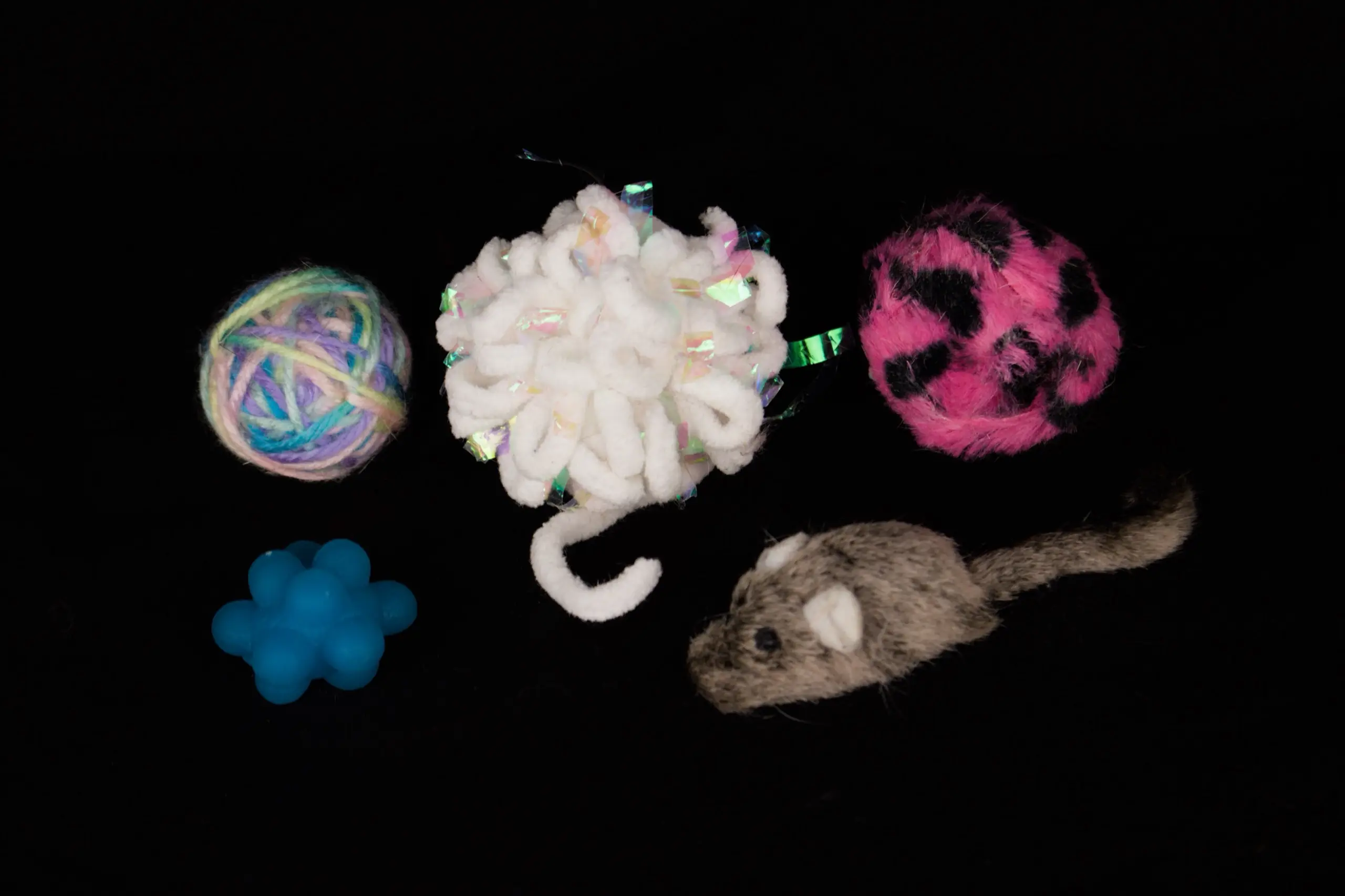
- Pets and streets: Try Dog with a ball and Cat toys above to see how colored objects can lose contrast against their surroundings, or switch to Traffic by day and Street at night to see how colored lights and signs shift.
Charts and maps that add labels or patterns, not just color, are usually easier to read.
Why it is more common in men
Inherited red-green color blindness is passed down on the X chromosome, which is why it is much more common in men than in women. Men have one X chromosome while women have two, so one X chromosome carrying the gene is enough for a man to have red-green color blindness, while a woman needs it on both. That is rare.
Blue-yellow (tritan) deficiency follows a different pattern and affects men and women equally.
Not all color vision changes are present from birth. Color vision can also change later in life with some eye or brain conditions, or with certain medicines. If you or someone in your family notices colors looking different than before, schedule an eye exam with an optometrist or ophthalmologist to find out why.
How this simulator works and its limits
This tool runs in your browser and transforms each scene using published color vision models, based on DaltonLens-Python (MIT license):
- Deuteranomaly and protanomaly: Machado, Oliveira & Fernandes (2009), with the severity slider.
- Deuteranopia and protanopia: Viénot, Brettel & Mollon (1999).
- Tritanopia: Brettel, Viénot & Mollon (1997).
- Achromatopsia: shown as grayscale only. Its light sensitivity and reduced sharpness are not shown here.
This simulator is an approximation meant to show people with typical color vision which colors can look alike. Real color perception varies from person to person, and screens vary in brightness, color settings, and lighting.
This simulator is for learning only. It is not a color vision test, cannot detect or rule out color blindness, and gives no medical or treatment advice. Only an eye exam by an optometrist or ophthalmologist can tell whether someone is color blind.
FAQ
Do color blind people see in black and white?
Usually not. Most color blind people see many colors, though shades like red, green, orange, and brown can look alike. Seeing only black, white, and shades of gray happens in complete achromatopsia, which affects about 1 in 30,000 people worldwide.
What is the most common type of color blindness?
Deuteranomaly, a red-green type where certain shades of green look more red. Among populations with Northern European ancestry, red-green deficiency affects about 1 in 12 men and 1 in 200 women; a UK estimate puts deuteranomaly at about 5% of men.
What do color blind people see at traffic lights?
With red-green color blindness, red and green signals can look more alike. Traffic lights also have a fixed order (on a vertical US signal, red is at the top and green at the bottom), so the position of the lit signal carries the same message as its color. Try Traffic by day and Street at night above to see the color shift.
Is color blindness more common in men?
Red-green color blindness is much more common in men because it is passed down on the X chromosome—about 1 in 12 men versus 1 in 200 women among populations with Northern European ancestry. Blue-yellow deficiency affects men and women equally.
Can you become color blind later in life?
Yes. While most color blindness is inherited, color vision can also change later in life with some eye or brain conditions or some medicines. If you notice a new change in how colors look, see an optometrist or ophthalmologist for an eye exam.
Is this a color blindness test?
No. This page is a simulation for learning only and cannot detect or rule out color blindness. Only an eye exam by an optometrist or ophthalmologist can tell whether someone is color blind.
What does the severity slider change?
Deuteranomaly and protanomaly range from mild to strong. The severity slider (default 60%) adjusts how strongly colors shift in the Machado, Oliveira & Fernandes (2009) model—lower values show a milder shift, and higher values move closer to deuteranopia or protanopia. The simulator shows the other four types at full strength, so the slider is hidden for them.
Sources
- MedlinePlus Genetics. Color vision deficiency. https://medlineplus.gov/genetics/condition/color-vision-deficiency/
- MedlinePlus Genetics. Achromatopsia. https://medlineplus.gov/genetics/condition/achromatopsia/
- National Eye Institute (NEI). Types of Color Vision Deficiency. https://www.nei.nih.gov/learn-about-eye-health/eye-conditions-and-diseases/color-blindness/types-color-vision-deficiency
- National Eye Institute (NEI). Causes of Color Vision Deficiency. https://www.nei.nih.gov/learn-about-eye-health/eye-conditions-and-diseases/color-blindness/causes-color-vision-deficiency
- Cleveland Clinic. Color Blindness. https://my.clevelandclinic.org/health/diseases/11604-color-blindness
- Colour Blind Awareness. Types of Colour Blindness. https://www.colourblindawareness.org/colour-blindness/types-of-colour-blindness/
- Colour Blind Awareness. Living with Colour Vision Deficiency. https://www.colourblindawareness.org/colour-blindness/living-with-colour-vision-deficiency/
- Viénot F, Brettel H, Mollon JD. Digital video colourmaps for checking the legibility of displays by dichromats. Color Res Appl 1999;24(4):243–252. (protanopia and deuteranopia model)
- Brettel H, Viénot F, Mollon JD. 1997. https://doi.org/10.1364/JOSAA.14.002647 (tritanopia model)
- Machado, Oliveira & Fernandes. 2009. https://doi.org/10.1109/TVCG.2009.113 (protanomaly and deuteranomaly model)