Eyesight Simulator


Polarized lenses add a special filter that cuts much of the glare reflected off smooth surfaces like water, pavement, and car hoods, while non-polarized lenses dim the whole view evenly. Drag the divider to compare Without polarized lenses and With polarized lenses on Water glare and Puddle, then use Screen test below and slide Angle from 0° to 90° to see a drawn phone screen darken as the angle grows. The photos were shot with a camera polarizing filter rather than sunglasses, and this demo is for learning only—it cannot test your own lenses or measure UV protection.
What polarized lenses do
Polarized (anti-glare) lenses cut intense reflected glare before it reaches your eyes, which can help reduce eyestrain in bright sun. Non-polarized tinted lenses darken the whole scene, but they still let reflected glare through.
A polarized lens uses a special chemical filter that works like a miniblind in front of a window—only light aligned with the openings gets through. Glare bouncing off smooth horizontal surfaces travels sideways, so the filter lets vertical light in while blocking horizontal glare off water, pavement, car windows, or a car hood.
Through polarized lenses, a scene may look slightly darker, yet objects often appear sharper and details are easier to see. Many people feel less tired after hours in bright sun, especially during:
- Fishing and boating: Cuts surface glare so it is easier to see into the water and reduces eyestrain.
- Beach trips: Cuts reflected glare off water and sand.
- Golfing: Reduces glare on fairways (if they make putting harder, take them off on the green).
- Most snowy conditions: Snow reflects a lot of sunlight, so polarized lenses usually help—except when spotting ice.
Why glare is polarized
Direct sunlight is unpolarized, meaning its light waves vibrate in all directions. Uneven surfaces scatter that light everywhere, while smooth, flat surfaces—like calm water, wet roads, or glass—reflect light at one angle straight into your eyes as glare.
At a smooth horizontal surface, vertically polarized light waves tend to enter (refract into) the surface, leaving the reflected glare mostly horizontally polarized. Polarized sunglasses use a vertical filter axis, so they block far more reflected glare than ordinary unpolarized light.
The strength of the effect depends on the angle. At Brewster's angle, light reflected from a smooth surface is completely horizontally polarized—about 53.1° for air to water (and about 56.7° for crown glass). Near that angle, a vertical polarizing filter can block nearly all of the glare. At other angles, glare is only partially polarized, so it dims without always disappearing.
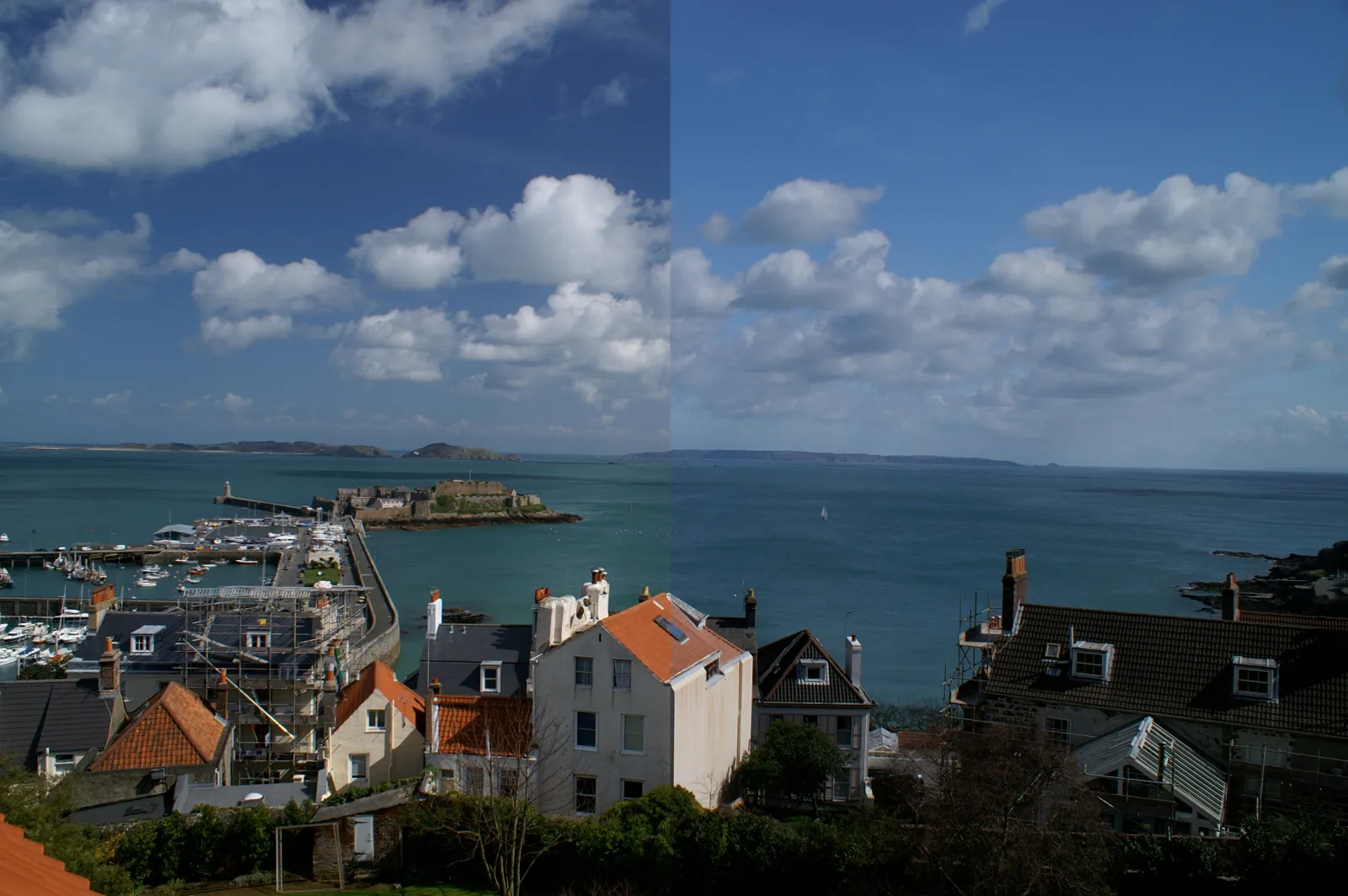
Sunlight scattered by air in a blue sky is also partially polarized. That is why the split sky photo below—one half shot with a camera polarizer turned for its strongest effect and the other half for its weakest—shows a darker blue sky on one side, making the clouds stand out more clearly.
Polarized vs non-polarized at a glance
| Situation | Without polarized lenses | With polarized lenses |
|---|---|---|
| Water, beach, fishing, boating | Surface glare can hide what is below the water and add eyestrain | Cuts water and sand glare; often makes it easier to see into water |
| Bright daytime driving | Dims the scene, but road and car-hood glare still gets through | Cuts glare off roads, windows, and hoods; may dim LCD dashboards |
| Icy roads or ski slopes | Snow glare can tire eyes, while icy shine stays visible | Cuts snow glare, but can make icy patches harder to spot |
| LCD screens (dashboards, phones, ATMs) | Tilting your head does not dim the screen | Can dim or turn hard to read at certain angles |
| Flying (pilots) | The FAA highly recommends a neutral gray tint | Not recommended by the FAA (cockpit displays, windscreens, traffic) |
| UV protection | Depends only on the UV label | Depends only on the UV label—polarization alone does not block UV |
When polarized lenses can be a problem
Blocking polarized light helps outdoors, but it can cause trouble in several everyday settings:
- LCD screens: Liquid crystal displays (LCDs)—in many car dashboard controls, cell phones, ATM cash machines, and some watches—rely on polarization to make images. As the angle between a polarized lens and the screen grows, less light passes through (dropping to 50% at 45° under Malus's law), and at 90° almost no light gets through. Try Screen test above to see this effect.
- Spotting ice: Polarized lenses can make icy patches harder to see while driving or skiing.
- Night driving: Polarized glasses sold for night driving may do more harm than good.
- Flying an aircraft: The Federal Aviation Administration (FAA) does not recommend polarized lenses for pilots. They can dim or blank out cockpit instruments with anti-glare filters, emphasize striations in laminated windscreens, and mask the glint of sunlight off another aircraft's wing or windscreen—cutting reaction time in "see-and-avoid" traffic situations. If a windscreen is polarized, the FAA considers polarized sunglasses unacceptable.
Polarized is not the same as UV protection or darker tint
Polarization and ultraviolet (UV) protection are separate features:
- Polarization does not block UV by itself. It only filters glare. Many polarized lenses also add a UV-blocking finish, and non-polarized lenses can block UV too, so check the label for each.
- Darker lenses do not mean more UV protection. Lens darkness, color, and mirror finishes tell you nothing about UV blocking. Price is not a guide either: inexpensive sunglasses labeled for full UV protection protect your eyes better than expensive pairs without it.
- What to look for on the label: Long-term UV exposure is linked to cataracts, eye growths such as pterygium, and eyelid cancers. Look for a label promising 100% UV protection or UV400 (also written "UV absorption up to 400nm"), as the American Academy of Ophthalmology (AAO) advises; the National Eye Institute (NEI) gives the same advice as 99% to 100% UVA and UVB protection.
- Fit, kids, and testing: Close-fitting or wraparound frames help keep UV from sneaking in at the sides. For kids who will not keep sunglasses on, a hat may be a more practical option. Many optical shops can also test existing lenses with a photometer.
Never look directly at the sun. Normal sunglasses—polarized or not, even with 100% UV protection—do not protect your eyes if you stare straight at the sun, including during a solar eclipse. Doing so can cause painful photokeratitis and even permanent retinal damage.
How to check if sunglasses are polarized
Check the label first—polarized lenses will say so. Without a label, three simple checks show whether a lens has a polarizing filter (none of these test UV protection):
- Cross two polarized lenses at 90°: Hold your glasses in front of a pair you know is polarized and rotate one pair 90°. If both are polarized, the overlap turns very dark, because perpendicular filters block nearly all light (real polarizing film is not ideal, so a faint bit of light may still pass).
- Rotate them at glare or blue sky: Hold the glasses up and turn them while looking at glare on water or glass—or at blue sky away from the sun. With polarized lenses, the glare or sky brightens and dims as you turn them.
- Tilt them in front of an LCD screen: Look at an LCD screen through the lenses and turn them 90°. With polarized lenses, an LCD screen usually darkens sharply near 90°.
How this demo works and its limits
This tool uses two real photo pairs and one interactive model to illustrate polarization:
- Water glare (tidal mudflats with bright sun glare on wet mud; Andrew Norman, public domain) and Puddle (a path puddle where sky reflection mostly disappears so you can see into the water; Esquilo, CC BY-SA 3.0) were shot with and without a camera polarizing filter. They show the same physics as polarized sunglasses, though a camera filter is not a specific pair of sunglasses and two shots can differ slightly in exposure.
- Screen test uses a drawn phone screen and an Angle slider (0° to 90°) to show how polarized light dims as a second polarizing filter rotates toward 90°. It assumes a fully polarized screen and an ideal lens; real screens and lenses vary.
- The split sky photo (Angus MacRae, CC BY 2.0) compares a camera polarizer turned for its strongest effect on one half and its weakest on the other.
This demo is for learning only. It does not test whether your sunglasses are polarized or how much UV they block, is not a substitute for an eye exam, and gives no medical, product, or purchasing advice. For questions about your vision or eye protection, consult an optometrist or ophthalmologist.
FAQ
Are polarized sunglasses better?
It depends on what you are doing. Polarized lenses are often more comfortable around water, sand, snow, and sunny roads because they cut reflected glare. Non-polarized lenses can be a better fit when you need to read LCD screens easily, spot icy patches, or fly an aircraft. Either type can offer full UV protection if labeled 99% to 100% UVA/UVB or UV400.
Are polarized lenses better for driving?
In bright daytime sun, polarized lenses can cut glare off pavement, car windows, and hoods. However, they can also make LCD dashboard controls harder to read and make icy patches on winter roads harder to spot. Polarized glasses sold for night driving may do more harm than good.
Why does my phone screen look black with polarized sunglasses?
Many LCD screens rely on polarizing filters to make their image, so light leaving the screen is polarized. When your sunglasses' filter is perpendicular (at 90°) to the screen's polarization, almost no light passes through, making the display look dim or black. Tilting your head or turning the phone usually restores the image.
Do polarized lenses protect against UV?
Not automatically. Polarization cuts glare, while UV protection blocks ultraviolet rays—they are separate features. Many polarized sunglasses also include a UV-blocking finish or material, so check the label for 99% to 100% UVA and UVB protection or UV400.
Do darker sunglasses block more UV light?
No. Lens darkness and color tell you nothing about UV protection. Always look for a label stating 99% to 100% UV protection or UV400, or ask a local optical shop to test your lenses with a photometer.
How can I tell if my sunglasses are polarized?
Check the label first, or try a home check: cross the lens at 90° with a known polarized pair (the overlap turns very dark), rotate the lenses while looking at glare off water or glass (the glare brightens and dims), or turn them in front of an LCD screen (the screen darkens at certain angles). None of these checks measure UV protection.
Can pilots wear polarized sunglasses?
The FAA does not recommend polarized sunglasses for pilots. They can reduce or eliminate the visibility of cockpit instruments with anti-glare filters, enhance striations in laminated windscreens, and mask the sunlight sparkle reflecting off other aircraft during "see-and-avoid" traffic scans. If a windscreen is polarized, the FAA states polarized sunglasses are unacceptable.
Sources
- American Academy of Ophthalmology (AAO). What Are Polarized Lenses?
- American Academy of Ophthalmology (AAO). How to Choose the Best Sunglasses to Avoid Sun Damage
- American Academy of Ophthalmology (AAO). Recommended Types of Sunglasses
- National Eye Institute (NEI). Protecting your eyes from the sun’s UV light
- Federal Aviation Administration (FAA). Sunglasses for Pilots (Aerospace Medical Education Division, AAM-400)
- Federal Aviation Administration (FAA). Guide for Aviation Medical Examiners — Items 31-34. Eye - Sunglasses
- OpenStax College Physics 2e. Section 27.8 Polarization
- HyperPhysics (Georgia State University). Polarization by Reflection
- HyperPhysics (Georgia State University). Crossed Polarizers
- HyperPhysics (Georgia State University). Methods for Producing Polarization (Polarization by Scattering)
- Picture credits